
Anúncios
Learning to play the piano is a rewarding journey that opens doors to creativity, discipline, and lifelong musical enjoyment.


The piano stands as one of the most versatile and accessible instruments in the world. Whether you’re drawn to classical compositions, jazz improvisations, or contemporary pop songs, the piano provides a foundation that translates across all musical genres. Starting this journey might seem intimidating at first, but with the right approach and mindset, anyone can learn to play beautifully.
Anúncios
What makes piano learning so special is that it engages both hands independently, trains your brain in remarkable ways, and offers immediate visual feedback through its linear keyboard layout. Unlike many instruments where notes are hidden or abstract, the piano lays everything out before you, making it surprisingly beginner-friendly despite its sophisticated reputation.
🎹 Why Learning Piano Transforms Your Brain
Neuroscience research consistently demonstrates that piano practice creates unique neural pathways. When you sit at the keyboard, you’re not just making music—you’re literally rewiring your brain for enhanced cognitive function.
Anúncios
Playing piano requires simultaneous coordination of visual processing, motor skills, auditory feedback, and memory recall. This multi-sensory engagement stimulates areas across both brain hemispheres, strengthening the corpus callosum that connects them. Studies show that pianists often demonstrate improved spatial-temporal reasoning, which translates to better mathematical and problem-solving abilities.
The discipline required for regular practice also builds executive function skills. Setting aside time each day to work through scales, exercises, and pieces teaches patience, delayed gratification, and goal-oriented thinking—skills that benefit every area of life beyond music.
📚 Choosing Your Learning Path: Traditional vs. Modern Methods
Today’s aspiring pianists enjoy more learning options than ever before. Understanding the differences helps you select the approach that fits your lifestyle, budget, and learning style.
Traditional In-Person Lessons
Working with a piano teacher provides personalized instruction, immediate feedback, and accountability. A skilled instructor identifies bad habits before they become ingrained, tailors lessons to your pace, and motivates you through challenging periods. The human connection and structured curriculum offer significant advantages, especially for children and those who thrive with external accountability.
However, traditional lessons require scheduling coordination, commute time, and typically cost between $30-$100 per hour depending on location and teacher expertise. Geographic limitations may also restrict access to quality instructors in some areas.
Digital Learning Platforms and Apps
Technology has democratized music education through interactive apps, video courses, and online tutorials. These platforms offer flexibility to practice anytime, often at a fraction of traditional lesson costs. Many use gamification, instant feedback through MIDI recognition, and progressive curricula designed by professional musicians.
The best digital platforms combine structured lessons with popular song libraries, keeping motivation high by letting you play music you actually enjoy. They’re particularly effective for adult learners with unpredictable schedules who need learning to fit around work and family commitments.
Hybrid Approaches
Many successful learners combine methods—using apps for daily practice and technique building while meeting with a teacher monthly or quarterly for guidance and repertoire selection. This balanced approach maximizes flexibility while maintaining expert oversight.

🎼 Essential First Steps for Absolute Beginners
Starting correctly establishes habits that will serve your entire musical journey. These foundational elements deserve careful attention from day one.
Understanding Keyboard Geography
The piano keyboard follows a repeating pattern of 12 notes—seven white keys and five black keys. Recognizing this pattern helps you navigate even an 88-key instrument with confidence. The black keys are grouped in sets of two and three, providing visual landmarks to identify notes quickly.
Middle C serves as your home base—the reference point from which all other notes are measured. Located approximately at the center of the keyboard, it’s typically right in front of where you sit. Learning to find middle C instantly becomes second nature with just a few practice sessions.
Proper Posture and Hand Position
Correct posture prevents tension and injury while enabling fluid technique. Sit at the center of the keyboard with feet flat on the floor. Adjust your bench height so forearms are parallel to the floor when hands rest on the keys. Your back should be straight but relaxed, not rigid.
Hand position follows a natural curve, as if holding a small ball. Fingers should be gently curved with fingertips meeting the keys, not flat or collapsed. Wrists stay level with forearms—neither raised nor dropped. This neutral position allows maximum control and prevents strain during extended practice.
Reading Basic Musical Notation
While some approaches emphasize playing by ear or following colored indicators, learning to read standard notation opens vast musical libraries. Start with the treble clef (right hand) and bass clef (left hand), understanding that lines and spaces represent specific notes.
Begin with simple recognition before attempting to sight-read. Practice identifying notes away from the piano using flashcards or apps. When the visual recognition becomes automatic, connecting notes to keys happens naturally.
🏗️ Building a Sustainable Practice Routine
Consistent practice matters more than marathon sessions. Research shows that distributed practice—shorter sessions spread across multiple days—produces better retention than cramming.
Quality Over Quantity
Twenty focused minutes daily outperforms two hours of distracted weekend practice. During your practice time, eliminate distractions. Put your phone in another room, close unnecessary browser tabs, and give the piano your full attention.
Structure each session with intention. Spend the first few minutes warming up with scales or exercises. Then work on challenging sections of pieces you’re learning, followed by playing through complete pieces you’ve mastered for enjoyment and confidence.
The Power of Slow Practice
Beginners often rush through pieces, believing speed demonstrates proficiency. The opposite is true—slow practice with accuracy builds neural pathways that enable eventual speed. If you can’t play something slowly with perfect rhythm and note accuracy, you can’t truly play it at all.
Use a metronome to maintain steady tempo. Start at a pace where you make zero mistakes, even if it feels absurdly slow. Gradually increase the speed by small increments only after achieving consistent accuracy. This methodical approach feels less exciting initially but produces dramatically faster progress.
Tracking Progress
Record yourself regularly—weekly or even daily. Recordings reveal issues you can’t hear while concentrating on playing. They also document progress that feels invisible day-to-day but becomes obvious when comparing recordings weeks apart.
Keep a practice journal noting what you worked on, challenges encountered, and breakthrough moments. This metacognitive reflection reinforces learning and helps identify patterns in your development.
🎵 Choosing the Right Instrument for Your Journey
The instrument you practice on significantly impacts your learning experience and enjoyment. While acoustic pianos offer unmatched touch and tone, they’re not always practical or necessary for beginners.
Acoustic Pianos: Uprights and Grands
Acoustic pianos produce sound through hammers striking strings, creating rich, resonant tones that respond to your touch dynamics. Grand pianos offer superior action and tone but require substantial space and investment. Upright pianos provide excellent sound in a compact footprint.
Quality acoustic pianos hold value well and can last generations with proper maintenance. However, they require regular tuning, climate control, and professional moving. They also produce sound that neighbors might not always appreciate.
Digital Pianos: Modern Practicality
Digital pianos sample acoustic piano sounds and reproduce them through speakers or headphones. Modern digital pianos feature weighted keys that simulate acoustic action remarkably well. They never need tuning, offer volume control and headphone jacks for silent practice, and typically cost less than comparable acoustic instruments.
For beginners, a quality digital piano with 88 weighted keys provides everything needed to develop proper technique. Look for models with graded hammer action, where lower keys feel heavier than higher ones, mimicking acoustic piano response.
Keyboard Controllers and Portable Options
61-key keyboards work for initial exploration but limit repertoire as you advance. If budget requires starting with a smaller keyboard, plan to upgrade within the first year. Weighted keys matter more than key quantity—unweighted keys teach incorrect technique that’s difficult to unlearn.
🚀 Overcoming Common Beginner Challenges
Every pianist encounters obstacles. Recognizing these challenges as normal parts of the learning process helps you persist through frustration.
Hand Independence Struggles
Training your hands to play different rhythms and melodies simultaneously feels impossible at first. Your brain initially wants both hands to mirror each other. Break pieces into hands-alone practice, mastering each part separately before attempting to combine them.
Simple exercises like playing steady quarter notes with one hand while the other plays eighth notes build independence gradually. Celebrate small victories—this skill develops over months, not days.
Reading Music While Playing
The cognitive load of reading notation, finding keys, and maintaining rhythm overwhelms many beginners. Simplify by isolating skills. Practice reading notation without playing. Practice hand positions without reading. Then combine elements gradually.
Look-ahead reading—training your eyes to read notes before your hands play them—develops with consistent practice. Start with extremely simple pieces where this skill can develop without overwhelming difficulty.
Maintaining Motivation Through Plateaus
Progress follows a stair-step pattern, not a straight line. You’ll experience periods where improvement seems impossible despite consistent practice. These plateaus precede breakthroughs—your brain is consolidating skills behind the scenes.
Combat monotony by varying repertoire, exploring different musical styles, and setting short-term achievable goals. Performing for supportive friends or family, even informally, provides motivation and performance experience.
🎭 Developing Musical Expression Beyond Notes
Playing correct notes represents just the beginning. Music communicates emotion and tells stories through dynamics, tempo variations, and phrasing.
Understanding Dynamics
Dynamics describe volume—from pianissimo (very soft) to fortissimo (very loud) and everything between. Learning to control volume independently of tempo adds dramatic depth to performances. Practice scales at different dynamic levels, maintaining evenness at each volume.
Dynamic contrast creates interest. A piece played at constant medium volume sounds flat regardless of note accuracy. Exaggerate dynamics in practice to develop control, then refine to appropriate levels.
Tempo and Rubato
While maintaining steady tempo matters for rhythm development, musical performances incorporate subtle tempo flexibility called rubato—literally “stolen time.” Advanced players slow slightly at phrase endings or before climactic moments, then recover the time elsewhere.
This expressive freedom comes after establishing solid rhythmic foundations. Master metronome-perfect playing before adding interpretive timing variations.
Phrasing and Breathing
Musical phrases work like sentences in language. Understanding where phrases begin and end, and shaping them with slight emphasis on important notes, transforms mechanical playing into communication. Listen to professional recordings, noticing how pianists shape phrases.
Sing or hum melodies before playing them. Your natural musical instinct for vocal phrasing transfers to your hands when you consciously connect the two.
🌟 Setting Realistic Goals and Measuring Success
Clear goals provide direction and motivation, but unrealistic expectations create discouragement. Understanding typical progression timelines helps set achievable milestones.
Short-Term Goals (Weeks to Months)
Initial goals should focus on consistency and fundamentals rather than specific pieces. Commit to daily practice for 30 days. Master all major scales in one octave. Learn to identify and play all white key notes without hesitation.
Choose simple pieces slightly below your maximum ability level. Building a repertoire of fully-mastered easy pieces creates confidence and performance-ready material.
Medium-Term Goals (3-12 Months)
By six months of consistent practice, most adults can play simple popular songs, hymns, or easier classical pieces with both hands. You’ll recognize common chord progressions and might begin playing simple accompaniments by ear.
Set specific repertoire goals—perhaps learning one new piece monthly while maintaining previous pieces. Participate in a recital or record a polished performance for friends.
Long-Term Vision (Years)
Piano mastery unfolds over decades, not months. Intermediate proficiency—playing moderate classical pieces, contemporary music, and improvising simple melodies—typically requires 3-5 years of consistent practice. Advanced skills develop over decades.
Rather than comparing yourself to prodigies or career pianists, measure progress against your past self. Are you playing things today that seemed impossible six months ago? That’s success.
🎊 The Joy of Making Music Your Lifelong Companion
Learning piano offers rewards far beyond the notes themselves. The instrument becomes a creative outlet, stress reliever, and source of lifelong learning.
Unlike many skills that reach endpoints, music offers infinite depth. There’s always another piece to learn, another technique to refine, another style to explore. This endless horizon means you’ll never exhaust the piano’s possibilities, providing engagement and challenge throughout life’s stages.
The piano community welcomes learners at every level. Online forums, local music groups, and informal jam sessions connect you with fellow musicians. Sharing your musical journey creates friendships rooted in common passion and mutual encouragement.
Perhaps most importantly, music-making provides profound personal satisfaction. There’s something deeply human about creating beauty with your own hands, translating written symbols into living sound, and expressing emotions too complex for words alone. This connection to humanity’s ancient tradition of music-making enriches life in ways both subtle and profound.
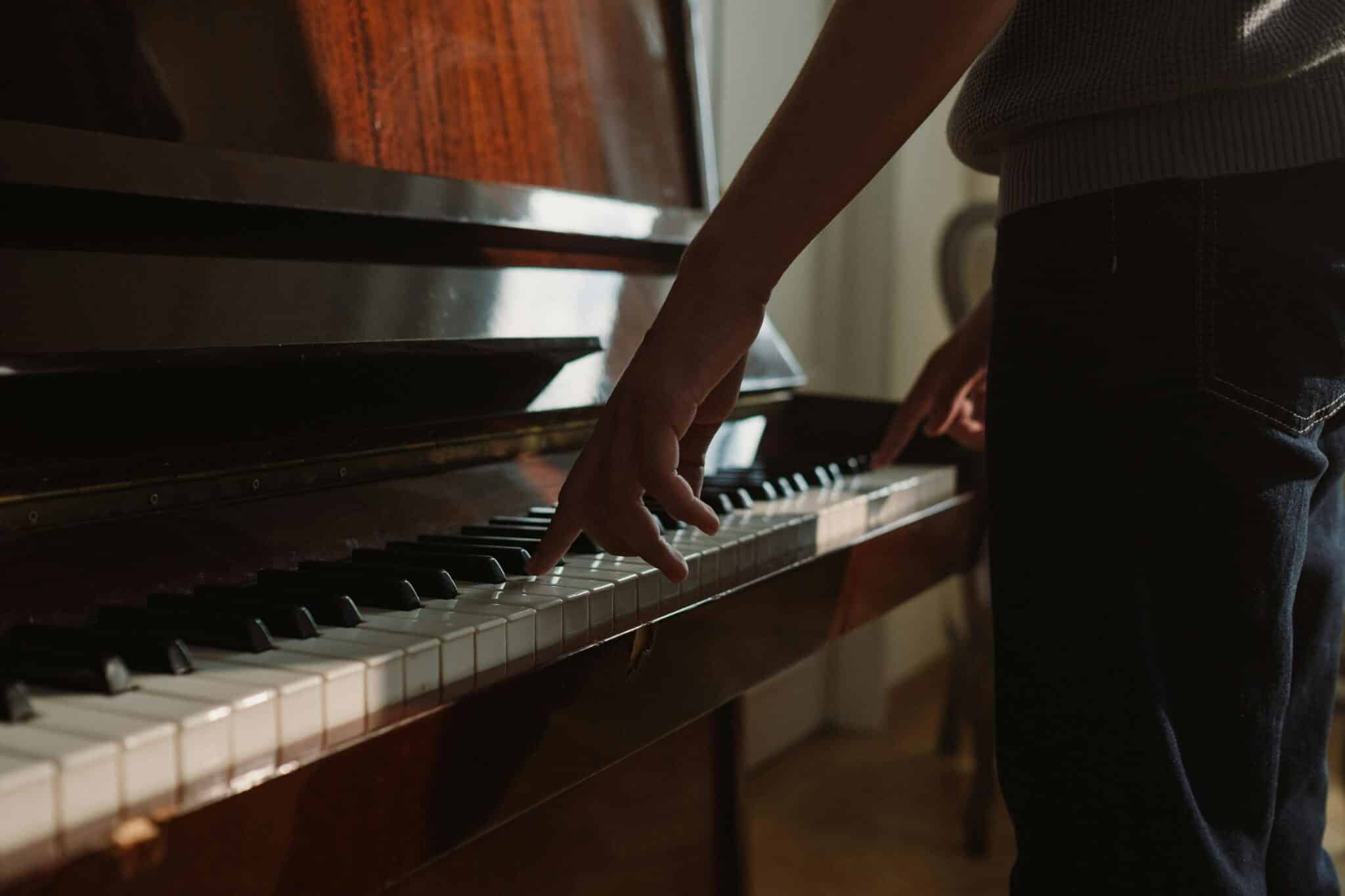
🔑 Your First Note Awaits
Every accomplished pianist began exactly where you are now—at the threshold of possibility with no guarantee of success except the commitment to begin. The journey from curious beginner to confident player happens one practice session at a time, one note at a time, one small victory at a time.
The perfect time to start was years ago. The second-best time is today. The piano waits patiently, offering its voice to anyone willing to learn its language. Your musical story begins with the simple courage to sit down, place your hands on the keys, and play your first note.
That note might be tentative, imperfect, even wrong. It doesn’t matter. What matters is that you played it, and you’ll play another, and another, until one day you’ll realize you’re not just pressing keys—you’re making music. And that transformation, from curiosity to capability, represents one of life’s most rewarding adventures. 🎹✨
